
Pupil Premium
'Purpose
The pupil premium grant provides funding to improve educational outcomes for disadvantaged pupils in state-funded schools in England. The service pupil premium (SPP) provides support for children and young people of service families. It is combined into pupil premium payments to make it easier for schools to manage their spending. Pupils that the SPP intends to support are not necessarily from financially disadvantaged backgrounds.
Eligibility For Funding Pupil Premium
Funding criteria
Pupil premium funding is allocated to eligible schools based on the number of:
- pupils who are recorded as eligible for free school meals (FSM), or have been recorded as eligible in the past 6 years (referred to as Ever 6 FSM)
- children previously looked after by a local authority or other state care including children adopted from state care or equivalent from outside England and Wales
Pupil premium is not a personal budget for individual pupils, and schools do not have to spend pupil premium so that it solely benefits pupils who meet the funding criteria. It can be used:
- to support other pupils with identified needs, such as those who have or have had a social worker, or who act as a carer
- for whole class interventions which will also benefit non-disadvantaged pupils
Pupil premium funding is allocated to local authorities based on the number of:
- looked-after children, supported by the local authority
- pupils who meet any of the eligibility criteria and who attend an independent setting, where the local authority pays full tuition fees
For pupils who are looked-after children, funding should be managed by the local authority’s virtual school head (VSH) in consultation with the child’s school. Details of the funding criteria for SPP are outlined in the Service pupil premium section.
Implications of the free school meals expansion on pupil premium
From the start of the 2026 to 2027 academic year, the Department for Education (DfE) is delivering an expansion to FSM eligibility to include all pupils from households in receipt of Universal Credit. There will then be two categories of FSM:
- Targeted FSM, which continues to be based on the existing £7,400income threshold
- Expanded FSM, which will apply to meals only, covering pupils who do not qualify for Targeted FSM, but who are in households in receipt of Universal Credit
Following the expansion of FSM, only pupils eligible for Targeted FSM will be part of the Ever 6 FSM cohort. This means that pupils who become eligible for FSM for the first time through the new Expanded FSM category will not attract pupil premium funding. Pupils who were eligible for FSM before the expansion will continue to be part of the Ever 6 FSM cohort after the expansion. That includes any pupil whose household income increases after the expansion, such that they either lose FSM eligibility altogether or become eligible for FSM through Expanded FSM. Such pupils will remain part of the Ever 6 FSM cohort for 6years.
All children in Reception, Year 1 and 2 qualify for free school meals, regardless of family income, but only the children who would have qualified for free meals under the above income-based criteria will receive the additional Pupil Premium funding.
Pupil Premium Plus
Pupil Premium Plus is funding to help improve the attainment of looked-after children and previously looked-after children. As with pupil premium, it is not a personal budget for individual children (DfE – Pupil Premium Overview May 2026)
Children who are looked after by the local authority
For looked-after children, pupil premium plus is managed by each local authority’s Virtual School Head for the purpose of supporting their educational attainment. Our Designated Teacher will work with Virtual School Heads to ensure that pupil premium plus for looked after children is used to meet the needs identified in their personal education plans (PEP).
Local authorities are expected to release these payments as soon as possible to schools, but they may choose to retain a portion of it to fund activities that will benefit a group, or all, of the authority’s looked-after children.
Pupils who were previously looked after by the local authority
Pupil premium plus for previously looked-after children is managed by the child’s school, alongside their pupil premium funding. The Designated Teacher has a key role in ensuring the specific needs of previously looked-after children are reflected in how the school uses its funding to support these children.
Service Pupil Premium
Service pupil premium is additional funding for parents who serve in the armed forces.
Pupil Premium Grant Payments 2026-2027
The amounts are outlined in the table below:
|
Ever 6 and FSM |
LAC / Post LAC (looked after children) |
Ever 6 Service Child |
|
£1550 |
£2690 |
£360 |
Statement Of Intent
At Cawthorne CE (VC) Primary School, our purpose is to ‘promote life in all its fullness’ so that all children develop and flourish in every aspect of their lives. In order to achieve this, all members of our school community accept responsibility for our children especially those who are ‘socially disadvantaged’. We are committed to being with them ‘Every step of the way’ to ensure that we meet their pastoral, social, emotional and academic needs within our caring, nurturing and inclusive environment. We aim for each child to develop a love of learning whilst acquiring the skills, knowledge and abilities commensurate with fulfilling their potential and being ready for the next stage of their education.
Cawthorne Pupil Premium Objectives
- The Pupil Premium will be used to provide additional educational support to improve the progress and to raise the standard of achievement for these pupils
- The funding will be used to narrow and close the gap between the achievement of these pupils and their peers:
School Disadvantaged – School Other
School Disadvantaged – National Disadvantaged
School Disadvantaged – National Other
We will ensure that the additional funding reaches the pupils who need it the most and that it makes a significant impact on their education and lives
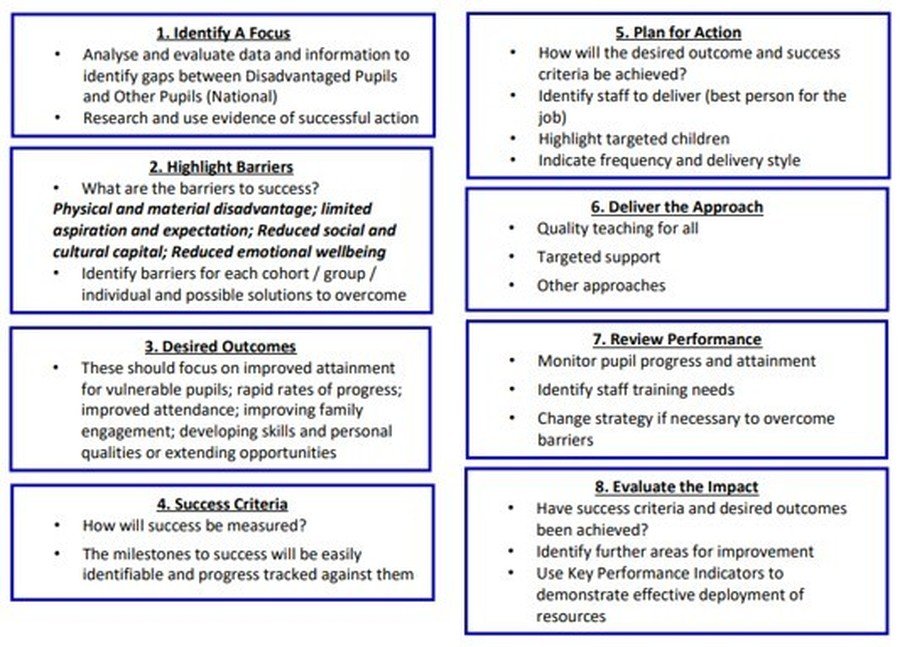
Pupil Premium Strategies Cawthorne CE (VC) Primary School will use the PPG funding in a number of imaginative ways in order to close the gap between disadvantaged pupils and other pupils in school and nationally. We will develop a carefully planned and comprehensive strategy in order to minimise and in many instances remove the barriers to learning and achievement.
Barriers to achievement
The main barriers to educational achievement that impact our children fall into the categories:
- physical and material disadvantage (including some instances of poor housing and severe poverty)
- Limited aspiration and expectation (which can manifest itself in a lack of parental engagement)
- Reduced social and cultural capital (children may not be exposed to rich and varied experiences)
- Reduced emotional wellbeing
Our Pupil Premium Strategy